
KumoMTA vs PowerMTA: choosing a self-managed MTA
KumoMTA vs PowerMTA for high-volume senders: license, configuration, traffic shaping, injection, event data and support, plus what neither does for you.
· 5 min read · By Reda El Kasraoui

TL;DR: KumoMTA and PowerMTA do the same job: deliver large volumes of email from IPs you own, with per-destination throttling and traffic isolation. KumoMTA is open source (Apache 2.0), configured in Lua and built for teams comfortable with DevOps; PowerMTA is Bird's commercial MTA with a declarative configuration file, virtual MTAs and a long track record among high-volume senders. Choose KumoMTA if you want no license fee and scriptable policy and can operate it; choose PowerMTA if you want a vendor-supported product your team may already know. Neither manages lists, suppression or offers, so you still need a platform in front of it.
An MTA (mail transfer agent) is the server software that hands messages to mailbox providers over SMTP, retries deferrals and records the result. Traffic shaping means limiting connections and messages per destination (Gmail, Yahoo, Microsoft) and backing off when a provider defers you. A virtual MTA (in PowerMTA) or an egress source (in KumoMTA) is a named sending path, usually one IP, that you use to isolate one stream's reputation from another's.
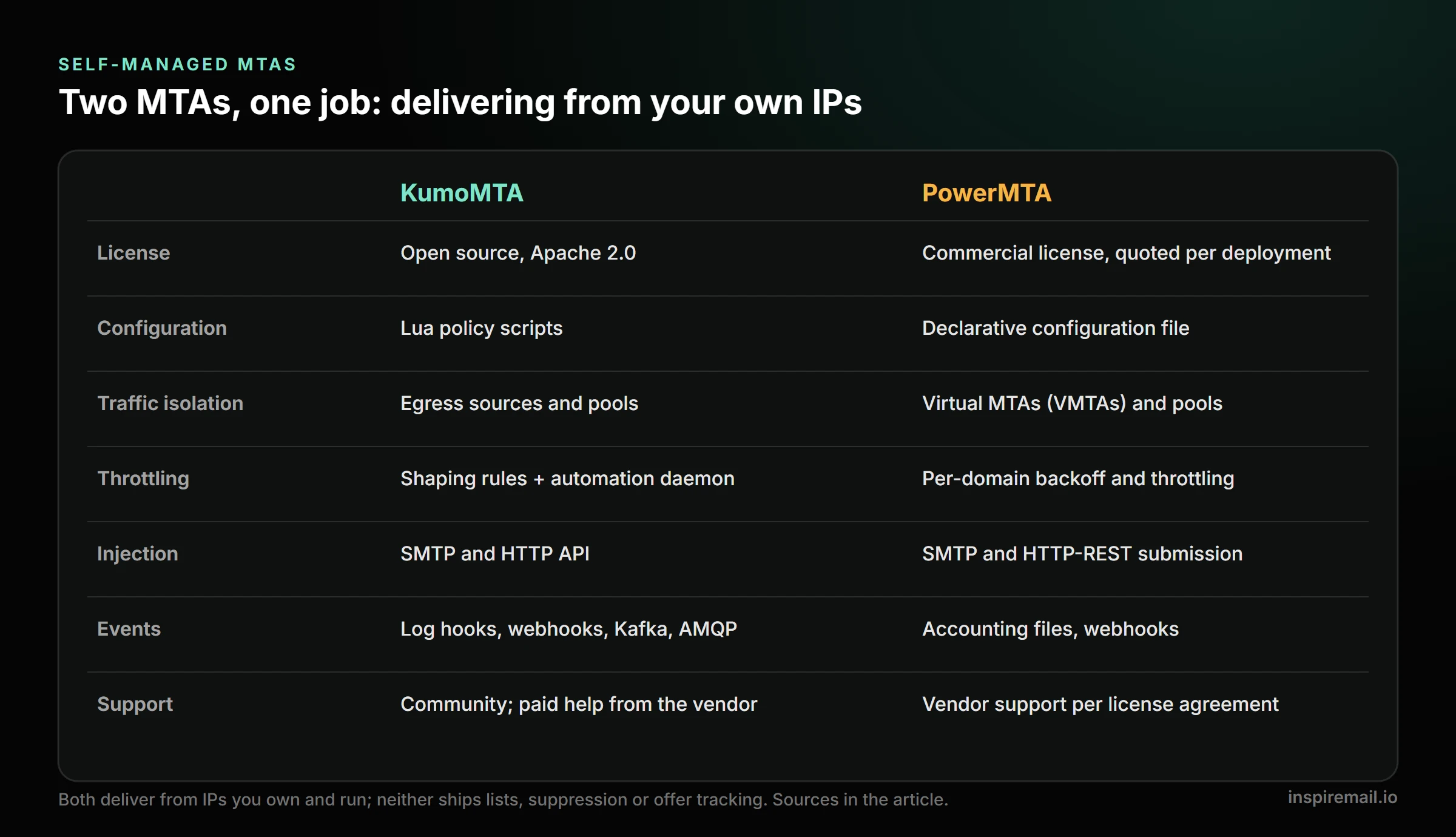 Two MTAs, one job: delivering from your own IPs
When a self-managed MTA is worth it
Running your own MTA is a staffing decision before it is a software decision. It tends to pay off when:
- Volume is high and steady, so dedicated IPs stay warm and per-message ESP pricing adds up.
- You need control over IPs and routing: for example, separate pools per client, per brand or per stream.
- Your content policy no longer fits an ESP's acceptable use policy, even though your mail is permission-based.
It doesn't pay off when volume is irregular, when nobody on the team reads SMTP logs, or when the real problem is list quality. An MTA delivers what you give it; it won't fix complaints. Many teams keep ESP accounts for some streams and an MTA for others; see multi-provider sending.
License and cost
KumoMTA is released under the Apache 2.0 license, with the source on GitHub. There is no license fee; KumoCorp offers support and sponsorship options and professional services.
PowerMTA is licensed software. Bird's PowerMTA pricing page says the quote covers production and disaster-recovery servers, sending volume, term, renewal and support. Hosting, network and IPs are separate costs either way.
Configuration
This is the biggest day-to-day difference. KumoMTA's configuration is a Lua policy: the configuration concepts page explains that it can be static or built dynamically from other data sources. That makes conditionals and loops easy, and makes the config code you have to review and test.
PowerMTA uses a declarative configuration file with directives per domain, source and virtual MTA. Many operators know it well, and the shared vocabulary helps when you hire: for instance, "VMTA" is a term most deliverability engineers already use. KumoMTA's own guide to moving from PowerMTA notes that a PowerMTA VMTA is roughly a KumoMTA egress source, and that the flat file allows no conditionals or iteration, which Lua replaces.
Traffic shaping and isolation
Both shape traffic per destination, which is the core of an MTA's value.
- KumoMTA ships a traffic shaping helper with a community-maintained rules file and a traffic shaping automation daemon that adjusts limits when providers answer with deferrals. It also rolls up destination domains by MX automatically.
- PowerMTA, per Bird's product page, detects deferrals and rate-limit responses and throttles and pauses retries, with per-domain queue visibility and virtual MTAs to separate streams.
Shaping is not warmup. A new IP still needs a ramp, as described in the email warmup schedule guide.
Injection and events
Your platform hands messages to the MTA and needs results back.
| KumoMTA | PowerMTA | |
|---|---|---|
| Injection | SMTP listener and an HTTP API | SMTP, plus HTTP-REST submission in recent versions |
| Delivery results | Log hooks, webhooks, Kafka or AMQP | Accounting files, webhooks for accounting data |
| Bounce classification | Configurable in policy | Built-in bounce categories |
The Bird blog on PowerMTA in the cloud lists HTTP-REST submission and accounting webhooks among its newer features. Whichever MTA you pick, decide early how bounces, deferrals and feedback-loop complaints reach your suppression list. That pipe matters more than raw throughput.
What neither MTA does
An MTA has no idea which offer a message promotes, whether the recipient opted out of that advertiser, or which drop earned a conversion. You still need:
- Lists, consent records and your global suppression.
- The advertiser's suppression file applied per drop.
- Authentication and a branded tracking domain per sender.
- Drop planning, a stop rule, and reporting tied to postbacks.
That is the job of the platform in front of the MTA. In Inspiremail, an own MTA is integrated on request: we build it with you against your MTA's HTTP API or authenticated SMTP and its event feed, and it then appears in Deploy next to the built-in providers. The process is in the own MTA integration guide and on the own infrastructure page.
A quick decision guide
- No one on the team runs Linux servers or reads SMTP logs: stay on ESP accounts for now (Amazon SES bulk email).
- You want no license fee and policy as code, and you can operate it: KumoMTA.
- You want a vendor-supported product, or your operators already know it: PowerMTA.
- Either way: plan the event pipeline and suppression before the first IP is warmed.
How we checked this guide
The facts come from the KumoMTA documentation, repository and blog and from Bird's PowerMTA pages linked above, read on 23 November 2026; we compared 7 criteria from those pages side by side. We don't resell either MTA. For the wider workflow, see the affiliate email marketing guide. If something here no longer matches, contact us and we'll correct it, as our editorial policy describes. Read more about us.
Frequently asked questions
Is KumoMTA a drop-in replacement for PowerMTA?
Not drop-in, but migrations are common. The concepts map closely: a PowerMTA virtual MTA is roughly a KumoMTA egress source, and both shape traffic per destination. The configuration has to be rewritten from PowerMTA's file format into KumoMTA's Lua policy.
Is KumoMTA free?
The software is open source under the Apache 2.0 license, so there is no license fee. You still pay for servers, IPs, monitoring and the people who run it, and the vendor sells professional services if you want help.
How is PowerMTA licensed?
PowerMTA is commercial software from Bird. The license is quoted per deployment: production and disaster-recovery servers, sending volume, term and support level.
Do I need my own MTA to send affiliate offers?
No. Most senders start with ESP accounts such as Amazon SES or SendGrid. An own MTA makes sense when your volume, IP control or content policy no longer fits an ESP, and when you have someone who can run it.
Does Inspiremail connect to KumoMTA or PowerMTA?
On request. There is no self-serve connector today; Inspiremail scopes and builds the integration with you against your MTA's HTTP API or authenticated SMTP and its event feed, and your MTA then appears in Deploy next to the built-in providers.
- KumoMTA vs PowerMTA
- kumomta
- powermta
- mta
- dedicated ips